The Story of Coffee · Chapter 1
Published: November 2, 2026
A Little Red Berry That Changed the World
Where did coffee originate? Discover the forests of Ethiopia, the legend of Kaldi, and the beginnings of a beverage that would change the world.
A Discovery Lost to History
Every morning, millions of people reach for a cup of coffee without giving much thought to where it all began.
Some press a button. Others measure freshly ground beans, heat water, or wait patiently while a familiar machine does its work. Within minutes, the kitchen fills with an aroma that signals the beginning of another day.
But imagine a world in which no one had ever tasted coffee.
No espresso bars. No neighborhood cafés. No steaming mugs beside breakfast plates. Not even the familiar smell of roasting coffee beans.
Long before any of those things existed, a small flowering plant was growing in the highland forests of northeastern Africa.
It had glossy green leaves, fragrant white flowers, and fruits that commonly turned a brilliant red as they ripened. Inside those fruits were seeds—usually two—that held the potential for something extraordinary.
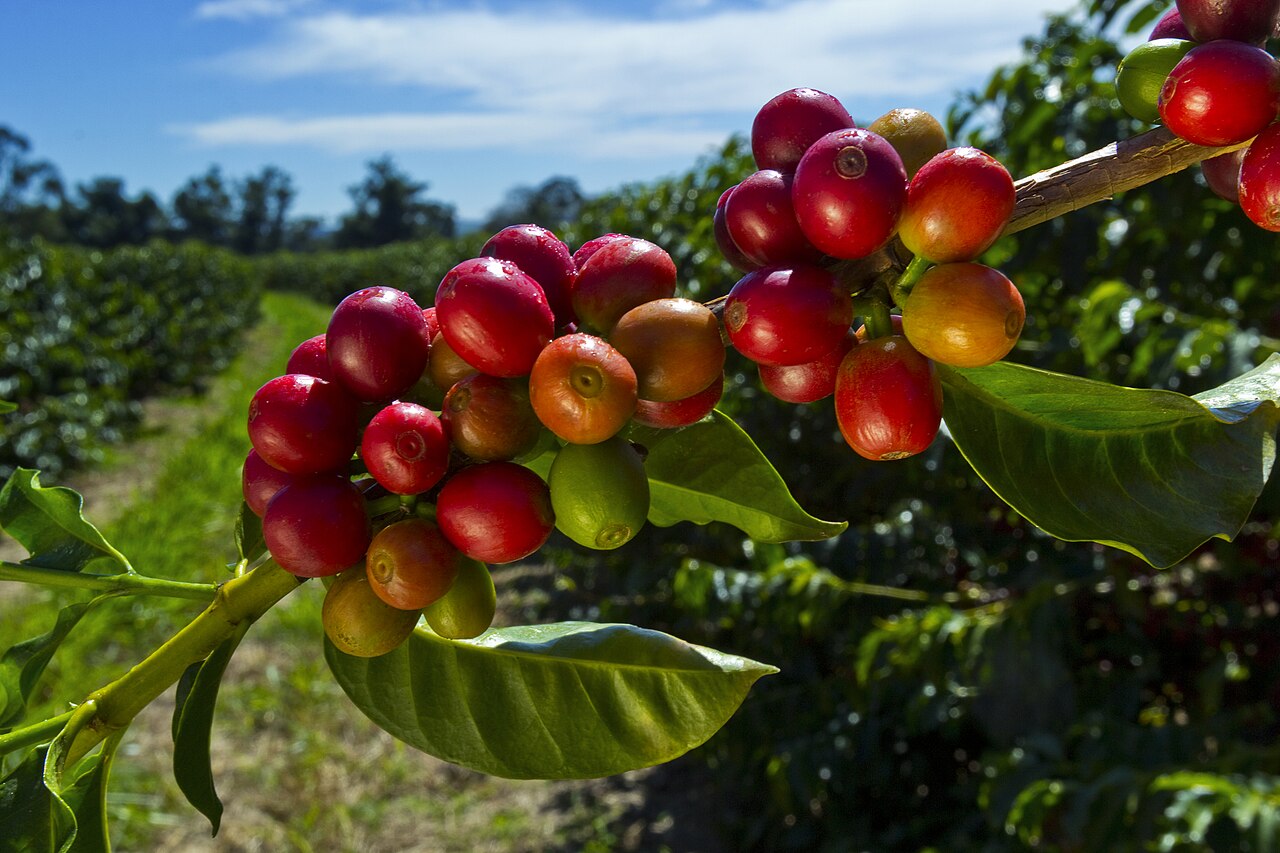
Coffee cherries ripening on the branch. Photograph by Jonathan Wilkins, via Wikimedia Commons, licensed under CC BY-SA 3.0.

Today, we call those seeds coffee beans.
At some point in the distant past, people discovered that this plant possessed unusual properties. Perhaps they noticed the effects of its fruit. Perhaps they experimented with different ways of preparing it. Or perhaps the discovery emerged gradually, through generations of experience.
No one knows exactly when it happened or who deserves the credit.
For something that has become so thoroughly woven into everyday life, coffee has a surprisingly mysterious beginning.
And, as with many good mysteries, there is a legend.
The Goatherd Who Noticed Something Strange
The most famous story of coffee’s discovery begins with a young goatherd named Kaldi.
According to the familiar legend, Kaldi was tending his goats in the Ethiopian highlands when he noticed something peculiar.
After eating bright red berries from a certain shrub, the animals became unusually energetic. They leaped about, refused to settle down, and seemed to possess a remarkable supply of energy.
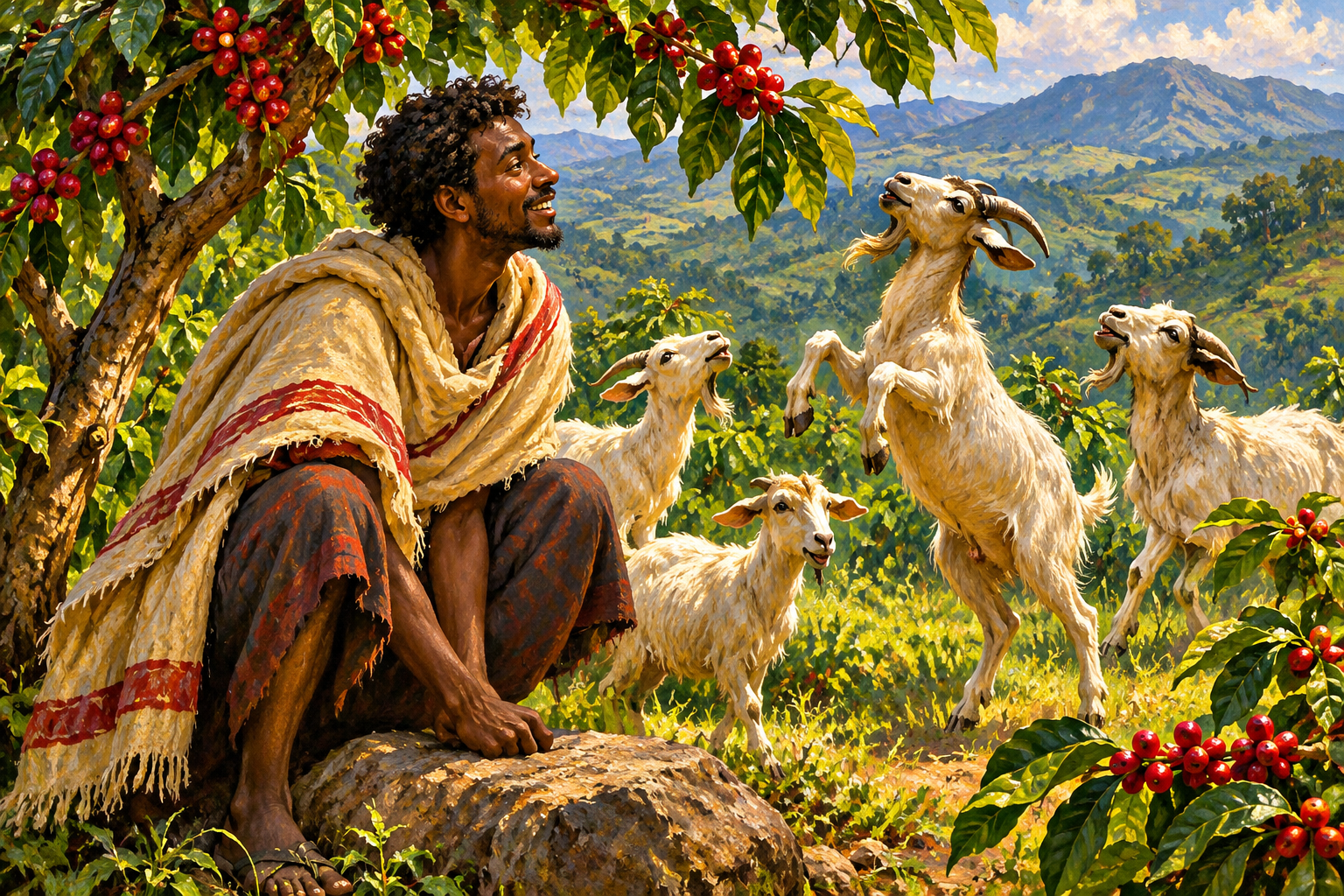
An artistic interpretation of the legend of Kaldi, the Ethiopian goatherd whose curious goats are said to have discovered the energizing properties of coffee cherries.
Kaldi, naturally curious, supposedly sampled the berries himself.
He, too, experienced their stimulating effects.
In one popular version of the tale, Kaldi carried his discovery to a nearby monastery. A monk, suspicious of the berries, threw them into a fire. As they roasted, an enticing aroma filled the room.
The roasted seeds were eventually placed in hot water, and the world’s first cup of coffee was born.
It’s the sort of story that deserves to be told over coffee.
There’s just one difficulty: nobody has established that Kaldi actually lived.
An early written version of the animal-discovery legend appeared in 1671, in a treatise by Antonio Fausto Naironi. But that account placed the events in Yemen rather than Ethiopia. The herder was unnamed, and the animals were described as camels—or, in another telling, goats.
The familiar Ethiopian setting and the name Kaldi belong to later versions of the story. Exactly when those details became attached to the legend remains uncertain.
In other words, the story most coffee lovers know today is not a documented account of coffee’s discovery.
But that doesn’t make it uninteresting.
The legend captures a wonderfully human possibility: that someone, somewhere, first recognized coffee’s unusual properties by paying attention to the natural world.
Perhaps something like that happened.
Perhaps the discovery was less dramatic and unfolded over many generations.
History cannot tell us.
What it can do is take us to the forests where coffee’s botanical story began.
A Plant with Deep African Roots
In the highland forests of southwestern Ethiopia, wild Arabica coffee has grown for countless generations.
The plant is native to parts of northeastern Africa, including southwestern Ethiopia and eastern South Sudan. Botanical records also identify a population in northern Kenya, although the history of that population is less certain.
Ethiopia remains central to understanding the origins of the Arabica coffee that is familiar to so many drinkers today.
Unlike the orderly rows of modern coffee plantations, wild Arabica grows among other trees and vegetation, often beneath a forest canopy.
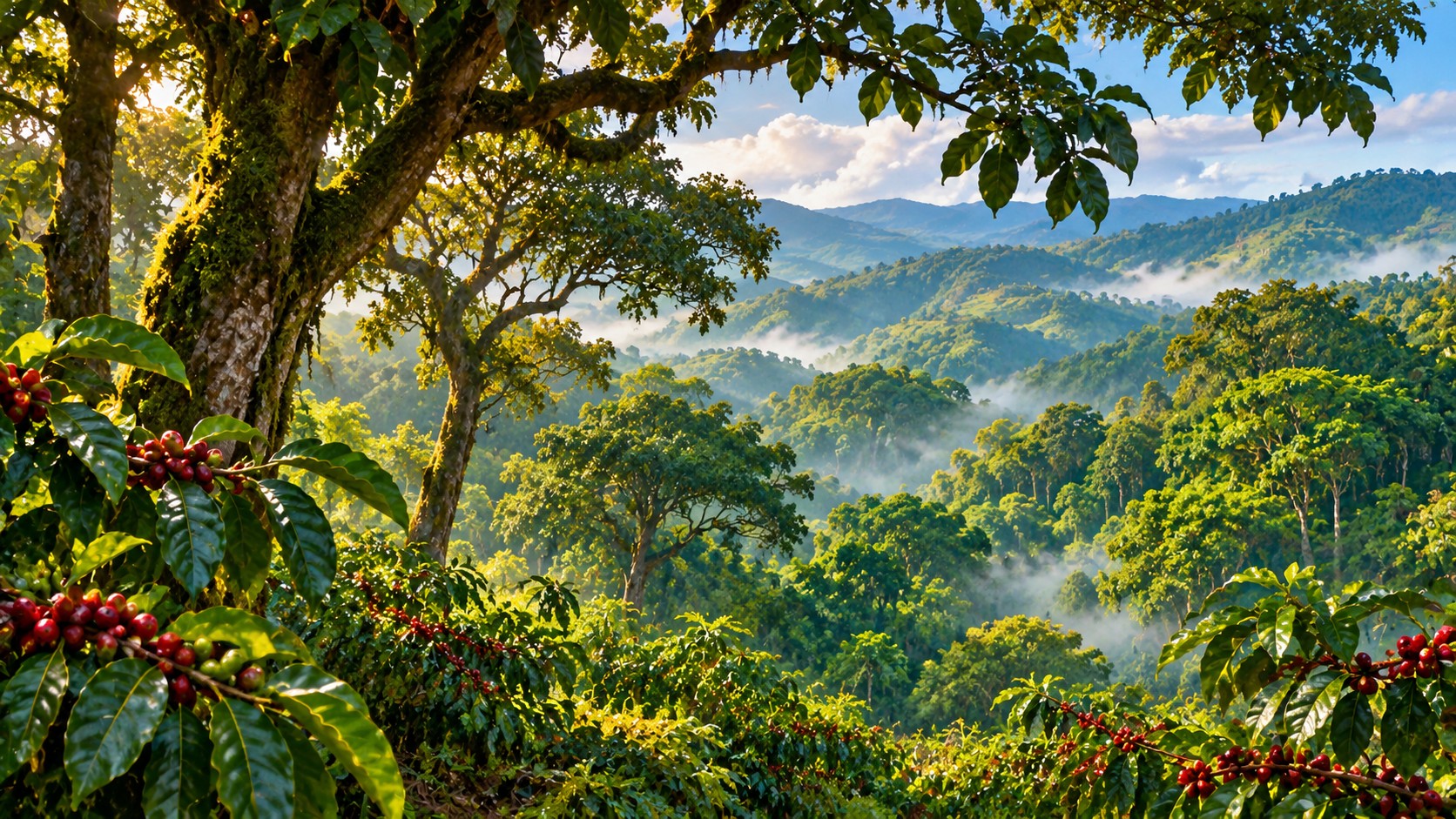
An artistic interpretation of Ethiopia’s lush highland forests, where wild Arabica coffee grows beneath a natural canopy of trees.
It is an evergreen shrub or small tree with shiny leaves and fragrant white flowers.
After flowering, the plant produces fruit. As the fruit matures, it commonly changes from green to red.
Inside are the seeds that, after processing and roasting, become the beans we recognize.
It’s a remarkable transformation.
Something that begins as a modest fruit on a forest plant eventually produces the rich aromas and flavors associated with coffee.
Yet the journey from fruit to beverage requires knowledge.
The seeds must be separated, prepared, and roasted. They must then be ground and combined with water in a way that produces the drink we know.
Those familiar steps are the result of human experience and innovation.
For communities living in the coffee-growing regions of Africa, the plant existed long before coffee became an internationally traded commodity.
Exactly how people first used it is difficult to establish.
Traditional accounts describe people eating coffee fruit, chewing parts of the plant, or preparing early forms of stimulating food and drink. Such stories may preserve memories of older practices, but their precise dates and details are not securely documented.
Historians have relatively little written or archaeological evidence describing coffee’s earliest human use in Ethiopia.
That leaves an important distinction.
We can identify the African origins of the plant with considerable confidence.
We cannot identify the first person who discovered its stimulating properties or establish precisely when the first recognizable coffee beverage was prepared.
The earliest chapters of coffee’s history remain partly hidden.
But across the Red Sea, the historical picture gradually becomes clearer.
Across the Red Sea
Between northeastern Africa and the Arabian Peninsula lies the Red Sea, a body of water that has connected communities for centuries.
Merchants, travelers, and religious pilgrims moved through the region, carrying goods, customs, and ideas between Africa and Arabia.
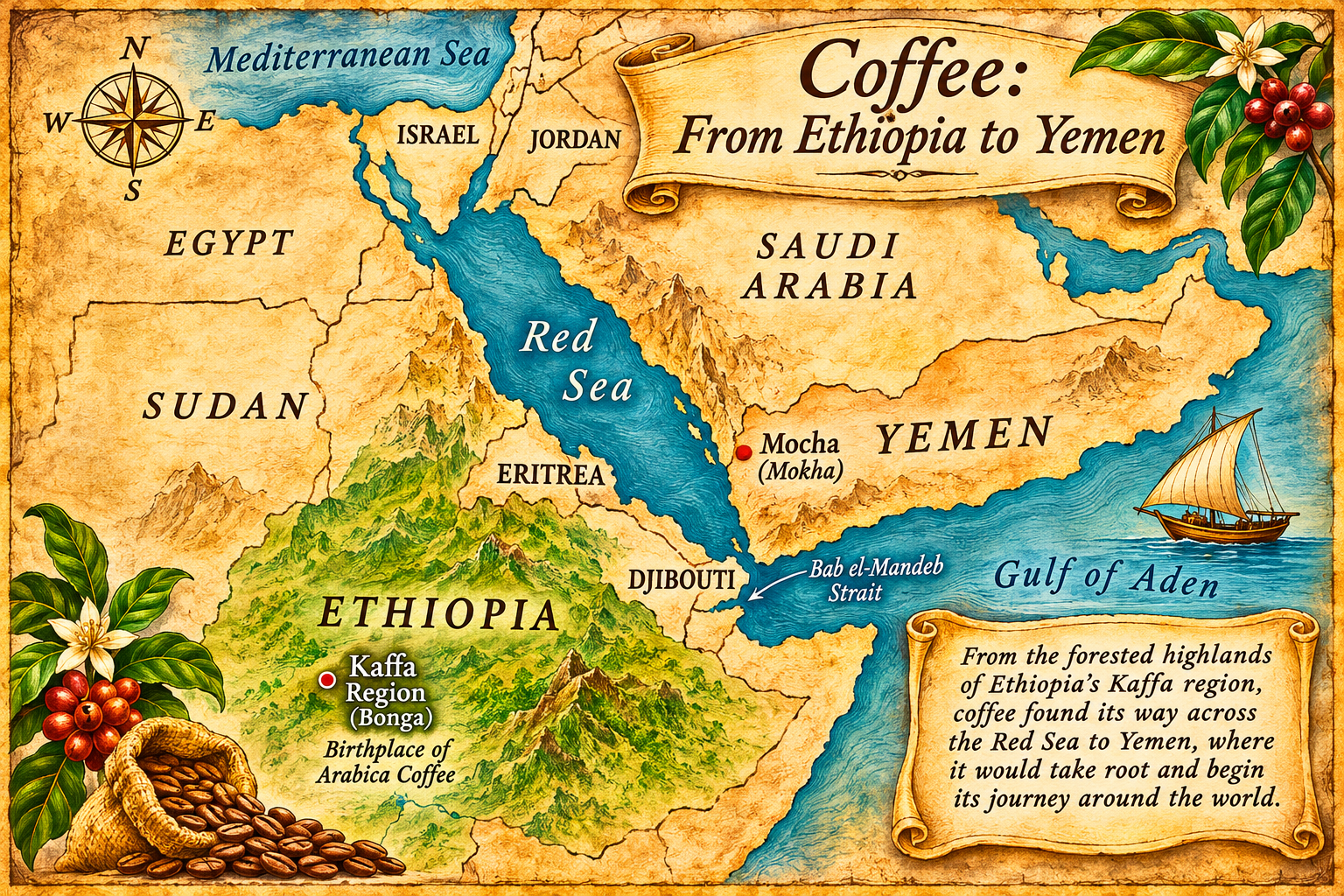
An illustrative map of northeastern Africa, Yemen, and the Red Sea, highlighting the regional connections through which coffee eventually traveled. The map is an artistic interpretation rather than a precise historical chart.
Coffee eventually became part of those connections.
The precise circumstances of its introduction into Yemen remain uncertain. No reliable historical account identifies a single person who brought the plant across the water or prepared the first cup.
By the fifteenth century, however, coffee drinking had become established among religious communities in Yemen.
Sufi practitioners found the beverage useful during extended periods of nighttime prayer and devotion.
Its stimulating properties helped worshippers remain awake and attentive.
This was an important turning point.
Coffee was becoming more than a plant with unusual effects. It was becoming a prepared beverage with a recognized place in religious and social life.
Its cultivation and commercial importance would grow over time.
By the late fifteenth century, wild coffee gathered in Ethiopia was entering regional trade. During the following century, coffee cultivation expanded in Yemen’s mountainous regions.
Farmers developed terraces on steep slopes, while merchants established trading networks connecting the region with markets farther away.
The growth was gradual, but its consequences would be enormous.
Coffee was beginning to move beyond the communities where it had first become familiar.
It was entering a wider world of cultivation, commerce, travel, and shared customs.
Eventually, that world would carry coffee far beyond the Red Sea.
But that is a story for our next chapter.
The Human Side of Coffee
Coffee’s history is often told through trade routes, inventions, and famous coffeehouses.
Yet one of its most enduring qualities has little to do with commerce.
Coffee brings people together.
In Ethiopia, the traditional coffee ceremony offers a particularly meaningful example.
The preparation can begin with green coffee beans roasted over heat, filling the surrounding space with their fragrance.
The roasted beans are ground and brewed in a traditional clay vessel called a jebena.
Coffee is poured into small cups and offered to guests. Several rounds may be served as people talk, exchange news, and enjoy one another’s company.
The ceremony is more than a method of brewing.
It is an expression of hospitality.
We cannot assume that modern Ethiopian coffee ceremonies are unchanged versions of the earliest coffee preparations. Traditions evolve, and their histories are complex.
But the ceremony illustrates something that has become central to coffee’s place in human life.
Coffee provides an occasion to gather.
Think about how often that simple idea appears in our own routines.
We invite a neighbor over for coffee.
We meet an old friend at a café.
We begin a conversation while waiting for a fresh pot to brew.
Sometimes the coffee itself is almost secondary.
What matters is the time spent together.
The customs may differ from one culture to another, but the human connection is familiar.
And that connection has become one of coffee’s most lasting contributions to everyday life.
From a Forest Plant to a Worldwide Phenomenon
Looking at coffee today, it’s difficult to imagine a world without it.
Coffee is grown across tropical regions, traded internationally, roasted in countless styles, and prepared using everything from simple pots to sophisticated machines.
Some people prefer black coffee brewed in a familiar kitchen.
Others enjoy espresso, cappuccino, cold brew, or coffee prepared according to traditions passed down through generations.
The variety is extraordinary.
Yet much of the coffee enjoyed around the world belongs to a species whose wild origins lie in northeastern Africa.
Coffee’s expansion was not the result of a single discovery.
It depended on generations of people learning to cultivate the plant, develop methods of preparation, transport its seeds, and introduce the beverage to new communities.
Its history would also become entangled with conquest, colonial expansion, coerced labor, and unequal economic relationships.
Those difficult chapters deserve attention. They are part of understanding how coffee became a global commodity, and we will encounter them as our historical journey continues.
But in its earliest chapters, coffee’s transformation was still unfolding.
The plant had become part of human experience in Africa.
Across the Red Sea, coffee drinking became established in Yemen.
Its stimulating properties found a place in religious practices, while cultivation and commerce gradually extended its reach.
The stage was being set for a remarkable transformation.
The Little Berry’s Extraordinary Future
The next time you prepare your morning coffee, consider what you’re holding.
The beans began as seeds inside the fruit of a flowering plant.
That plant’s history reaches back to the forests of northeastern Africa, where its earliest relationship with people remains partly hidden from the historical record.
Over time, communities discovered ways to use it, prepare it, and cultivate it.
Across the Red Sea, coffee became part of religious life and an emerging network of trade.
In the centuries ahead, it would find its way into bustling markets, crowded coffeehouses, European cities, American kitchens, and eventually homes around the world.
It would become a source of livelihood, a symbol of hospitality, a subject of controversy, and an everyday pleasure.
And today, something that once grew quietly beneath the forest canopy has become part of the way millions of people begin their day.
All from a little red berry.
Continue exploring: Visit The Story of Coffee series or browse our Coffee Buying Guides.