The Story of Coffee · Chapter 2
Published: November 2, 2026
Across the Red Sea — How Coffee Found Its Way to Yemen
Coffee’s roots lay in the highlands of Africa. But across the Red Sea, in the mountains of Yemen, the plant would become part of a remarkable new tradition—one that helped turn coffee into a drink the world would eventually embrace.
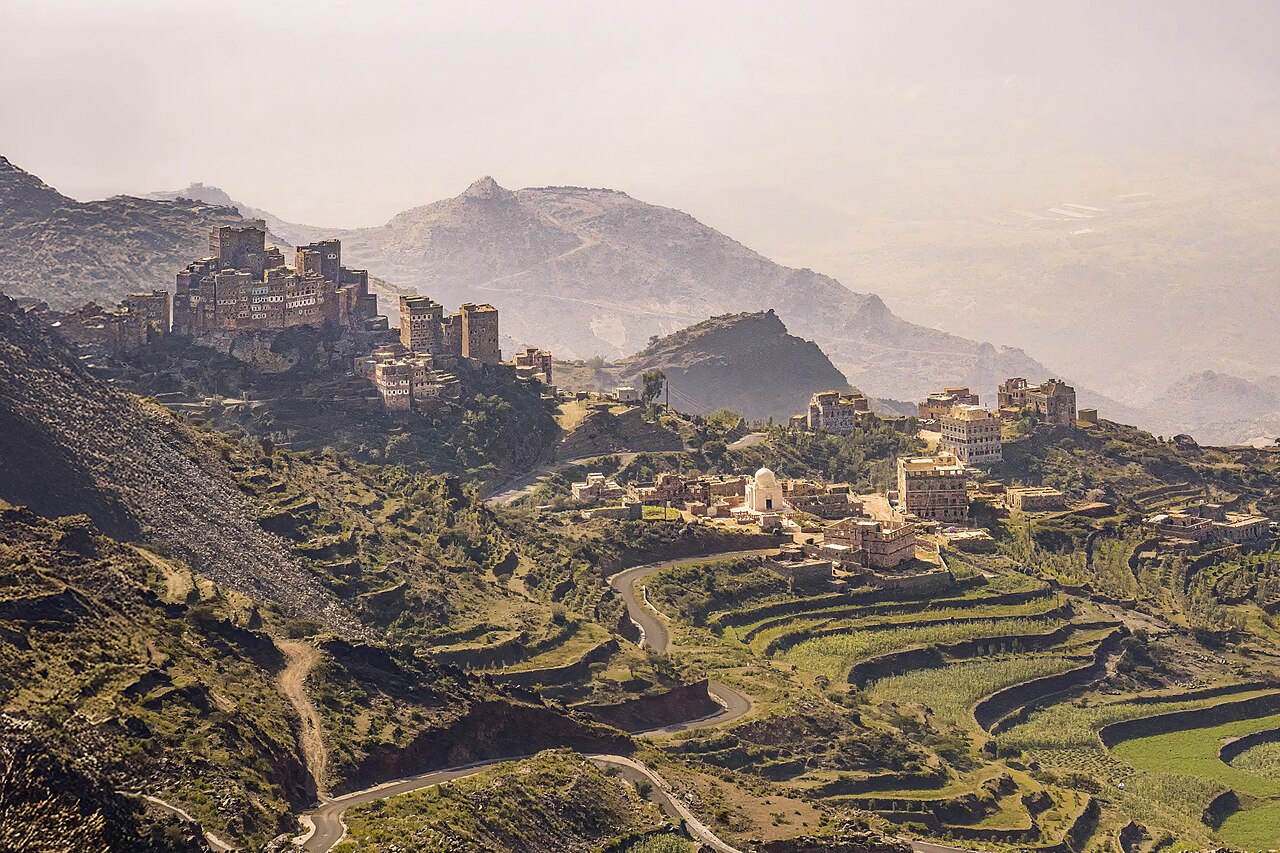
An artistic interpretation of Yemen’s Haraz Mountains, where villages and terraced hillsides reflect the landscape that helped shape the country’s coffee-growing traditions.
A Journey Without a Recorded Beginning
At the southern end of the Red Sea, Africa and the Arabian Peninsula draw remarkably close.
Here, near the narrow passage known as Bab-el-Mandeb, two continents face one another across waters that have connected their peoples for centuries.
Long before coffee became a familiar drink, merchants and travelers crossed between the African coast and Arabia. Their vessels carried goods that moved through trading networks stretching far beyond either shore. Along with merchandise came agricultural knowledge, customs, and ideas.
At some point in this long history of exchange, coffee made the crossing.
We do not know when.
No surviving account identifies the first person to bring coffee from Africa into Yemen. No known record describes a particular voyage or establishes the exact circumstances of its arrival.
It may have traveled as seeds, fruit, or living plants. Knowledge of its properties may have crossed the water along with the plant itself.
The details remain uncertain, and that uncertainty is part of the story.
Coffee’s early history is filled with legends offering neat explanations for events that were probably much more complicated. The surviving evidence rarely allows us to identify a single person or moment responsible for a development that unfolded over generations.
What we can establish is that arabica coffee originated in the African highlands, while Yemen became one of the earliest and most influential centers of coffee cultivation and drinking.
The Red Sea crossing helped connect those two chapters of coffee’s history.
And in Yemen, the plant would find conditions—and people—that changed its future.
A Place Among the Mountains
Yemen is sometimes imagined as a country of endless desert. Its western highlands offer a strikingly different landscape.
Mountains rise steeply above the coastal plains, their slopes marked by villages and terraces built into the hillsides.
Some terraces are narrow strips of land bordered by stone walls. Others follow the mountains in long, uneven bands, creating places to cultivate crops where the natural slopes would make farming difficult.
These terraces represent generations of agricultural work.
Farmers built and maintained them to protect soil, manage rainfall, and make productive use of limited land.
Coffee would eventually become one of the crops grown in this demanding environment.
The arabica plant generally favors moderate temperatures and sufficient moisture. Yemen’s higher elevations offered more suitable conditions than the hot coastal lowlands, although rainfall could be unpredictable and water remained precious.
Growing coffee required careful attention.
Terraces needed maintenance. Soil had to be protected from erosion. Young plants had to survive dry periods, and established trees depended on conditions that could vary from season to season.
The mountains were not an effortless home for coffee.
Yet Yemeni farmers developed the agricultural knowledge that allowed the crop to become increasingly important.
Exactly when the first coffee plants were cultivated in Yemen remains uncertain. The process did not necessarily begin with large plantations or organized commercial production.
It developed over time, as farmers learned to grow coffee and communities found reasons to value the harvest.
By the sixteenth century, coffee cultivation was expanding in Yemen’s highlands. During the following generations, mountain agriculture would help support a growing trade in the beans.
But coffee’s future depended on more than finding suitable soil.
People also had to discover what the plant could offer.
From Fruit to Beverage
A ripe coffee cherry gives little indication of the drink hidden within it.
The fruit is typically red when mature. Beneath its outer layers are the seeds that, after processing and roasting, become the coffee beans familiar to us today.
The transformation is remarkable.
Fresh coffee fruit does not possess the rich aroma of roasted beans. The familiar fragrance develops through changes that occur when the seeds are heated.
Yet the history of how people discovered and refined coffee preparation remains incomplete.
Early African traditions describe the use of coffee fruit and its stimulating properties. Some stories suggest that people chewed the fruit or consumed preparations made from parts of the plant.
Such accounts are interesting, but they do not provide a reliable step-by-step history of the first brewed coffee.
Nor can historians identify the person who first roasted coffee seeds or combined them with water to make a drink.
What becomes clearer in the surviving record is that coffee drinking had established a recognizable place in Yemen by the fifteenth century.
The drink’s appeal was partly practical.
Coffee contains caffeine, a naturally occurring stimulant that can promote wakefulness and alertness. Preparing coffee as a beverage allowed people to make use of those effects in a form that could be consumed and shared.
Roasting also introduced characteristics that would eventually become central to coffee’s appeal.
Heat changes the compounds within the seeds, producing aromas and flavors that distinguish roasted coffee from the original fruit.
The precise methods used by early Yemeni coffee drinkers are not fully documented. Their beverages may have differed in preparation, strength, and taste from the coffee we enjoy today.
Nevertheless, an important change had taken place.
Coffee was no longer simply a plant whose properties were known to certain communities.
It was becoming a prepared drink with an identifiable purpose and an audience that appreciated it.
One of the earliest historically recognizable settings for that development was found among communities that wanted to remain awake long after nightfall.
A Drink That Helped People Stay Awake
In fifteenth-century Yemen, some Sufi Muslim communities practiced extended periods of nighttime prayer and devotion.
Coffee offered a practical benefit during these observances.
Its stimulating properties helped participants remain awake and attentive.
Historical accounts connect coffee’s early use with Sufi communities and with figures such as Muhammad al-Dhabhani, a religious scholar associated with Yemen who died around 1470.
These accounts were not all recorded during the events they describe, and historians differ over how much can be established from their details.
They do not prove that al-Dhabhani invented coffee drinking.
What they do reveal is an important association between coffee and communities that found a regular purpose for the beverage.
Coffee could be prepared for gatherings, consumed for its effects, and shared among people who valued what it offered.
Its appeal would not remain confined to religious observances.
A drink that encouraged wakefulness could be useful in many circumstances. As coffee became more familiar, its stimulating qualities and developing flavors gave people reasons to seek it out.
Coffee was beginning to acquire something essential to its future: a place in human routines.

An artistic interpretation of an early Yemeni coffee gathering, illustrating how the beverage became part of shared social traditions. The scene is illustrative rather than a documented historical event.
And as demand grew, the people cultivating the crop became increasingly important.
The Work Behind Every Harvest
Before coffee could travel to distant markets, it had to be grown and prepared.
In Yemen’s mountains, that required patience, knowledge, and considerable labor.
Coffee trees needed time to mature. Their flowers had to develop into fruit, and the cherries had to ripen before harvest.
The work did not end when the fruit was picked.
The seeds had to be prepared in ways that allowed them to be stored and transported. Processing methods developed over time, influenced by the local climate, available resources, and agricultural experience.
Yemen became particularly associated with natural processing, in which harvested coffee cherries are dried before the beans are separated from the surrounding fruit.
Drying was well suited to a region where water could be scarce, although the surviving historical record does not tell us precisely when every element of these methods became established.
The result was a product that could be carried beyond the place where it grew.
This was essential to coffee’s expansion.
Fresh fruit is perishable. Properly dried coffee, by contrast, can be stored and transported over much greater distances.
That difference helped make coffee suitable for trade.
But the agricultural challenges remained considerable.
Yemen’s steep mountains limited available land. Terraces required maintenance, rainfall could be uncertain, and transporting harvests through rugged terrain demanded effort.
Coffee cultivation was not simply a matter of planting trees and waiting for a profitable crop.
It depended on generations of farmers who learned to work within the limitations of their environment.
Their knowledge helped turn coffee into an increasingly dependable agricultural product.
During the second half of the sixteenth century, more intensive coffee cultivation developed in Yemen, supporting an expanding trade.
The growing demand for coffee encouraged farmers and merchants to connect mountain communities with markets farther away.
Coffee was developing the agricultural and commercial foundations that would allow it to spread widely.
And much of that movement would eventually lead toward a port on Yemen’s Red Sea coast.
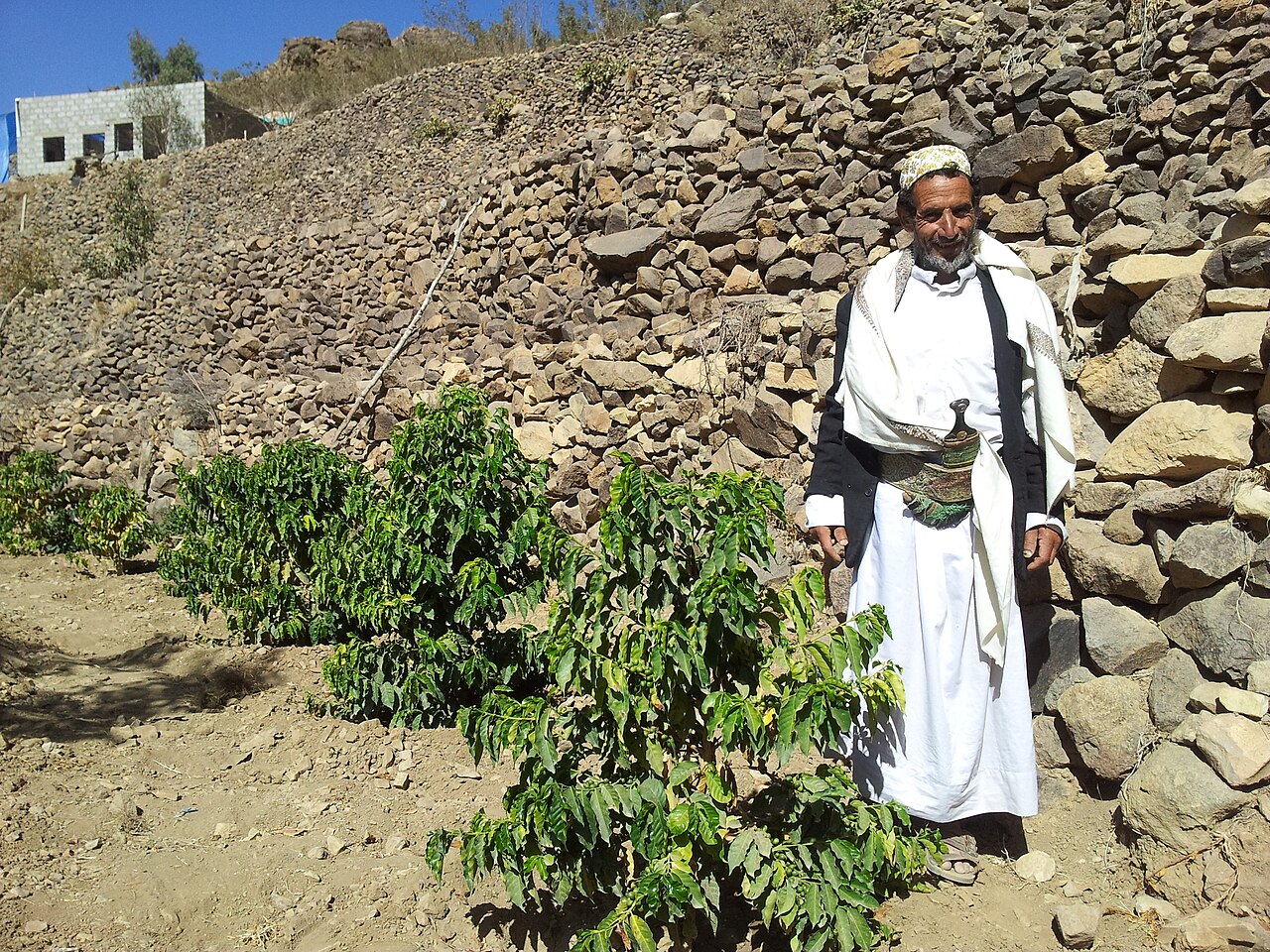
A Yemeni coffee grower beside coffee plants and stone terraces, illustrating the generations of agricultural knowledge behind the country’s coffee-growing traditions.
The Road to Mocha
From Yemen’s mountain growing regions, coffee entered trading networks that connected inland communities with coastal markets.
The journey was not simple.
Harvests had to move through difficult terrain before reaching merchants who could carry them farther. From the coast, goods could travel by sea to ports and cities throughout the region.
One Yemeni port would eventually become so closely associated with coffee that its name entered the vocabulary of coffee drinkers around the world.
Al-Makha.
Or, as it became known in English, Mocha.
Today, the word often brings to mind a drink made with coffee and chocolate. Its original connection to coffee, however, was geographical.
Mocha was the name of a port on Yemen’s Red Sea coast.
As coffee commerce expanded, Al-Makha became an important center for exporting Yemeni coffee. Its greatest prominence would develop in the seventeenth and eighteenth centuries, when coffee moved through increasingly extensive international trading networks.
The port’s name became associated with the beans shipped through it.
Long before modern cafés began serving chocolate-flavored mochas, the word referred to a place connected with coffee’s early commercial history.
For generations, farmers had cultivated coffee in Yemen’s mountains. Communities had developed ways to prepare and enjoy it. Merchants were beginning to carry it toward new customers.
Mocha would become one of the gateways through which that coffee reached a wider world.
But the greatest expansion was still ahead.
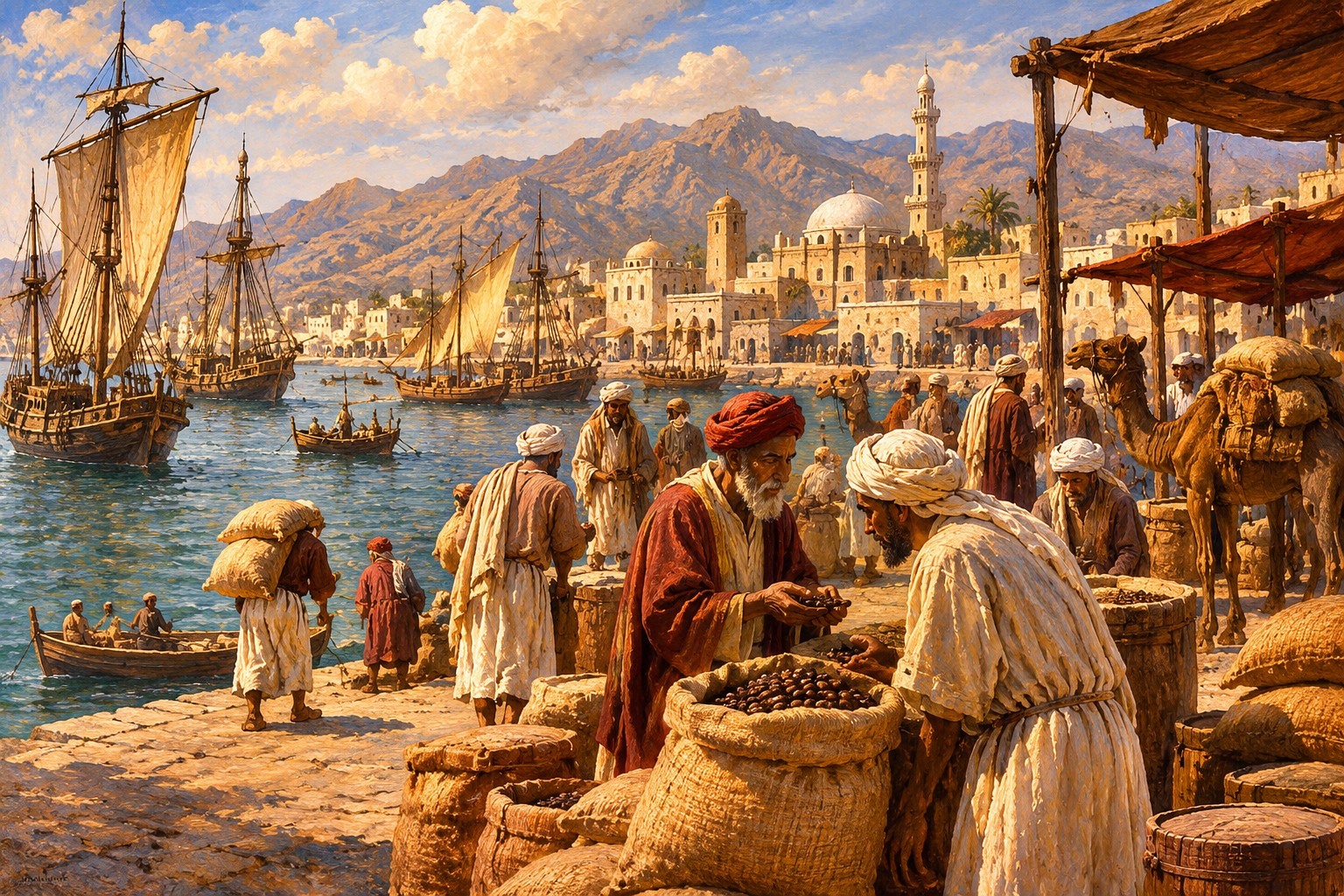
An artistic interpretation of the historic port of Mocha, where merchants and maritime trading networks helped carry Yemeni coffee to markets beyond the Arabian Peninsula.
Beyond the Mountains
The journey that brought coffee from Africa to Yemen left no single recorded beginning.
We do not know who first carried the plant across the Red Sea or exactly when the crossing took place.
Nor can we identify one person who transformed coffee into the drink that would eventually become familiar around the world.
The history is more complicated—and more interesting—than that.
Coffee’s development depended on connections between places and people.
The African highlands provided the plant. The Red Sea linked neighboring societies. In Yemen, communities helped establish coffee drinking, while farmers developed the cultivation and processing practices that supported growing demand.
Gradually, coffee acquired the qualities that would allow it to travel much farther.
It could be cultivated, prepared, stored, and traded.
And wherever people came to appreciate it, they had reasons to seek it again.
By the time coffee became established in Yemen, the foundations of a much larger story were in place.
The mountains had provided a home for the crop. The people had developed a place for the drink in their lives. The trading networks offered a path beyond the region.
Coffee was ready to leave the shores of the Red Sea.
Ahead lay the great cities of the Middle East, where the beverage would find new audiences and begin changing the ways people gathered, talked, and spent their time.
The little red berry from Africa had found its way to Yemen.
Now, the world was waiting.
Next in The Story of Coffee: Chapter 3 follows coffee beyond Yemen, exploring its spread through the Middle East and the beginnings of the coffeehouse tradition.
Continue exploring: Visit The Story of Coffee series or browse our Coffee Buying Guides.